
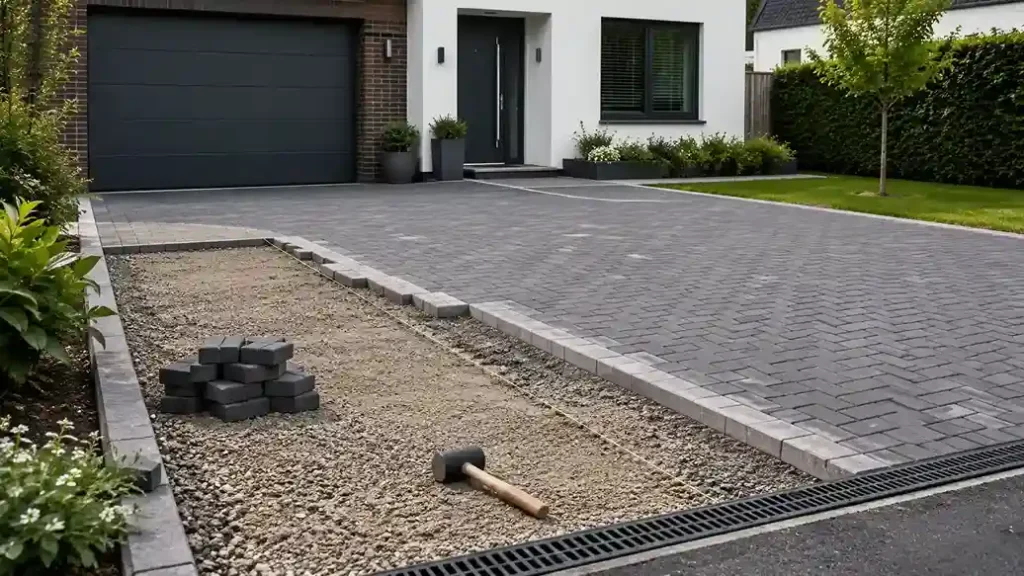
A new driveway can improve your property’s appearance, provide convenient off-road parking and make the entrance to your home more practical. However, a driveway will only deliver these benefits when it is properly planned and installed. Mistakes made during excavation drainage or material selection may not be obvious immediately. Problems often begin to appear later as standing water, sinking blocks, loose gravel, cracks or uneven sections. For homeowners planning a driveway installation in Bournemouth, avoiding the following mistakes can help create a surface that remains attractive, stable and functional for years.
What Is the Biggest Mistake When Installing a Driveway?
The biggest mistake is focusing only on the visible surface. Block paving, resin, gravel and tarmac are the parts people see, but the strength of a driveway comes mainly from the groundwork underneath. A visually attractive surface installed over a weak or poorly compacted base is likely to move, sink or deteriorate prematurely.
A reliable installation should consider:
- The existing ground conditions
- The expected vehicle weight
- Excavation depth
- Sub-base construction
- Drainage
- Surface levels
- Edge restraints
- The chosen finishing material
Each part of the installation needs to work as one complete system.
1. Starting Without a Proper Site Assessment
Every property is different. The condition of the soil, natural slope, drainage points and available access can all affect how a driveway should be designed. Beginning excavation without first assessing the site can lead to unexpected problems, including poor water flow, insufficient parking space or difficulty connecting the driveway safely to the road.
Before work starts, the installer should inspect:
- The size and shape of the proposed driveway
- Existing walls, paths and garden features
- The direction in which rainwater currently flows
- Nearby drains and utility covers
- Tree roots and vegetation
- Access from the public highway
- The number and type of vehicles using the driveway
A detailed assessment allows the driveway design to be adapted to the property rather than applying the same installation method to every home.
2. Ignoring Planning Permission and Local Requirements
Not every driveway project requires planning permission, but homeowners should check before beginning work. In England, planning permission is generally not required when a new or replacement driveway uses a permeable surface, or when rainwater is directed into a lawn or planting area where it can drain naturally. However, covering more than five square metres with an impermeable material may require planning permission when the water is not directed to a permeable area.
BCP Council also advises that planning permission will usually be required for a dropped kerb in certain circumstances, including when access leads onto a classified road, when the parking area uses an impermeable surface, or when the property is a flat, maisonette, commercial premises or listed building.
Properties in conservation areas may also be subject to additional restrictions. BCP Council explains that permitted development rights can be more limited in these areas, so homeowners should check their property’s status before changing the frontage. Checking the rules early can prevent delays, rejected applications or the need to alter completed work.
3. Driving Across a Pavement Without a Dropped Kerb
Creating a parking space within a front garden does not automatically give a homeowner permission to drive across the pavement. BCP Council states that a dropped kerb is required when a vehicle needs to cross the pavement to access a property. Vehicles should not be driven over a pavement that has not been properly lowered and strengthened.
This matters because a standard pavement is not designed to withstand repeated vehicle movements. Driving across it can damage paving, underground services and the kerb. Homeowners should apply for approval before arranging any work affecting the public highway. Contractors carrying out highway excavation must also hold the appropriate accreditation and licence.
4. Using an Inadequate Sub-Base
The sub-base distributes the weight of vehicles and helps prevent movement in the finished surface. If it is too shallow, poorly compacted or made from unsuitable material, the driveway may begin to sink.
Common signs of sub-base failure include:
- Depressions where vehicles regularly park
- Wheel tracks
- Moving or rocking blocks
- Cracked sections
- Puddles forming in low areas
The required excavation and sub-base depth will depend on the ground conditions, driveway material and expected traffic. A driveway used by several heavy vehicles may require a different specification from one used by a single small car. The sub-base should be installed in suitable layers and compacted thoroughly rather than placing a large amount of material into the excavation and compacting only the top.
5. Failing to Plan Effective Drainage
Poor drainage is one of the most common causes of driveway problems. Rainwater should not be allowed to collect against the house, flow onto neighbouring land or discharge uncontrolled onto the pavement and road. Standing water can also stain surfaces, encourage organic growth and contribute to movement during periods of cold weather.
Possible drainage solutions include:
- Permeable block paving
- Gravel installed over a suitable permeable base
- Porous asphalt or resin-bound systems
- Drainage channels
- Soakaways
- Directing water towards a lawn or planted border
The correct solution depends on the driveway design and ground conditions. Simply adding a channel drain without establishing where the collected water will discharge is not a complete drainage plan. Levels and gradients should be calculated before installation begins, not adjusted after the surface has already been laid.
6. Assuming All Permeable Surfaces Work in the Same Way
A surface should not be described as permeable merely because it contains small gaps or loose material. For example, standard block paving does not automatically create a permeable driveway. A genuinely permeable block-paving system normally requires compatible blocks, jointing material and a specially constructed sub-base that allows water to pass through.
Similarly, resin-bound and resin-bonded surfaces are not the same. Resin-bound aggregate is mixed with resin before being laid and can form a permeable surface when installed over a suitable base. Resin-bonded aggregate is scattered over a resin layer and is generally not permeable. Homeowners should ask how the complete driveway system manages water rather than judging the surface by appearance alone.
7. Choosing Materials Based Only on Appearance
The driveway material should suit the property, budget, drainage requirements and level of maintenance the homeowner is prepared to undertake.
Block paving: Block paving provides a wide choice of colours, patterns and edging styles. Individual blocks can also be lifted when access beneath the driveway is required. However, poor installation can result in movement, weeds or uneven sections.
Gravel: Gravel can provide a traditional and cost-effective finish. It also allows natural drainage when supported by a suitable base. Without proper edging or a stabilisation system, however, stones may spread onto paths and pavements.
Resin-bound surfacing: Resin-bound driveways provide a smooth, contemporary appearance and can be permeable when the full system is correctly specified. The quality of the base and installation conditions are particularly important.
Tarmac: Tarmac is practical and suitable for larger areas. Drainage and edge detailing still need careful consideration, especially where an impermeable installation is proposed. The best material is not necessarily the most expensive one. It is the material that suits how the driveway will be used.
8. Installing Weak or Incomplete Edge Restraints
Driveway edges help hold the surface and supporting materials in position. Without strong edge restraints, blocks can begin to spread, gravel can migrate into planted areas, and the sides of a tarmac or resin surface may deteriorate.
Particular attention should be given to:
- The entrance beside the pavement
- Curved sections
- Borders next to lawns
- Areas where vehicles turn
- Transitions between the driveway and existing paths
Edging should be treated as a structural part of the installation rather than a decorative addition.
9. Overlooking Trees, Roots and Underground Services
Excavating a driveway without checking the surrounding area can damage utility pipes, drainage systems, cables or tree roots. Large roots should not simply be cut to make space for the driveway. Removing or damaging them can affect the health and stability of a tree. The issue becomes more serious when a tree is protected.
BCP Council requires permission before work is carried out on a tree covered by a Tree Preservation Order. Trees within conservation areas may also be protected, even when they do not have an individual TPO. Utility locations, inspection covers and drainage access should be identified before excavation begins. Covers may need to be raised or replaced so they remain accessible and level with the completed surface.
10. Making the Driveway Too Small or Difficult to Use
A driveway can look suitable on a drawing but prove inconvenient in daily use. Homeowners should consider more than whether a vehicle technically fits within the available area. There should also be enough room to open doors, access bins, walk safely around parked cars and enter or leave the property without repeatedly driving over borders.
Consider:
- The number of vehicles
- Vehicle size
- Turning space
- Pedestrian access
- Visibility when entering the road
- Space for deliveries or visitors
- Possible future changes in vehicle type
Planning these details before construction is much easier than widening or redesigning a completed driveway.
How Can You Avoid Driveway Installation Problems?
The safest approach is to plan the entire driveway before excavation begins.
A well-managed project should include:
- A site survey
- Checks for permissions and restrictions
- A suitable drainage design
- Correct excavation and ground preparation
- A properly compacted sub-base
- Secure edge restraints
- Materials suited to the property
- Careful installation and finishing
- A clear maintenance plan
Homeowners should also receive a detailed quotation explaining exactly what is included.
Plan Your Driveway Carefully
Most driveway problems can be prevented before construction begins. Proper groundwork, effective drainage, appropriate materials and compliance with local requirements are more important than achieving the lowest initial price. NexGen Landscapes provides professional driveway installation services for homeowners in Bournemouth and surrounding areas. Our team can assess your property, discuss suitable materials and create a driveway designed around your space, drainage requirements and everyday parking needs. Contact NexGen Landscapes to arrange a site visit and request a free driveway quotation in Bournemouth.
Frequently Asked Questions
Do I need planning permission for a driveway in Bournemouth?
You may need permission if the driveway is over five square metres, uses an impermeable surface, or does not direct rainwater to a suitable drainage area.
Do I need a dropped kerb for my driveway?
Yes. An approved dropped kerb is normally required if vehicles must cross a public pavement to access your driveway.
Why do newly installed driveways sink?
Driveways often sink because of poor excavation, an inadequate sub-base, weak compaction, unstable ground, or ineffective drainage.
What is the best driveway material for a Bournemouth home?
The best material depends on your budget, property style, drainage needs, vehicle use, and preferred level of maintenance.
Can a driveway be installed over an existing surface?
It may be possible if the existing base is stable and suitable, but damaged or uneven surfaces should usually be removed first.
How long does driveway installation take?
Most residential driveways take several days to complete, although the timeframe depends on size, materials, groundwork, and weather conditions.
How can I prevent water from pooling on my driveway?
Correct gradients, permeable materials, drainage channels, and a properly designed sub-base can help prevent standing water.
How long should a new driveway last?
A professionally installed driveway can last many years, but its lifespan depends on the material, installation quality, traffic, drainage, and maintenance.