
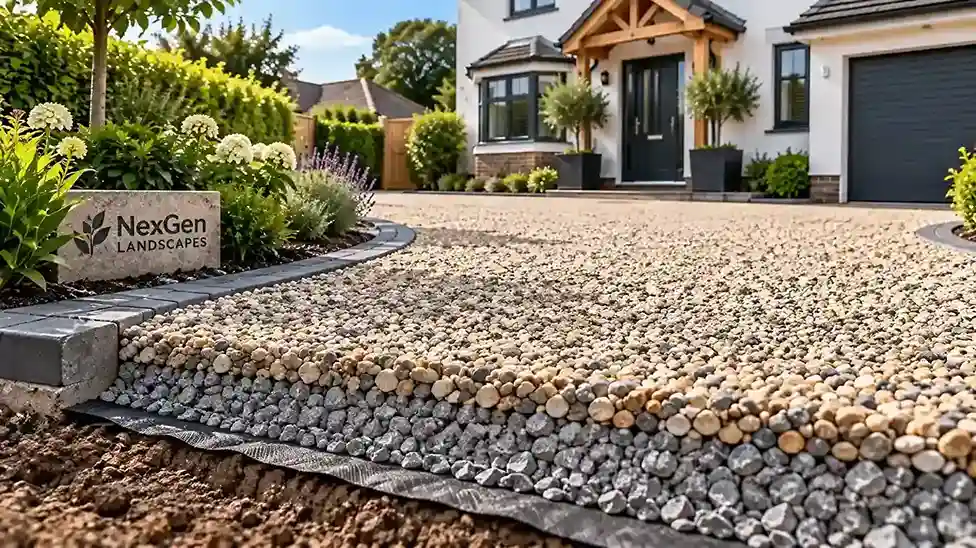
The best base for a gravel driveway in Bournemouth is generally a properly prepared, well-compacted sub-base that can support vehicle loads while allowing the driveway to remain stable and manage water effectively. The exact construction should depend on the existing ground, drainage, driveway use and chosen gravel rather than following one fixed specification for every property.
The decorative gravel that you see is only the final part of the driveway. Much of its long-term performance depends on the preparation underneath. If the supporting layers are unstable, simply adding more gravel is unlikely to prevent rutting, sinking or uneven areas.
Why Does the Base Matter So Much?
Think of gravel as the finish rather than the foundation. Cars place repeated loads on relatively small areas of a driveway. Without suitable support beneath the gravel, those loads can gradually deform the ground. Loose aggregate may then collect in depressions, wheel tracks become more noticeable and the surface can require frequent redistribution.
A correctly planned base helps provide:
- Stable support for regular vehicle use
- More consistent driveway levels
- Better distribution of vehicle loads
- Reduced risk of excessive settlement
- A firmer surface beneath the loose aggregate
- More effective management of surface water
This is why ground preparation should receive as much attention as the choice of decorative gravel.
What Is a Gravel Driveway Sub Base?
The sub-base is the structural layer between the prepared ground and the upper driveway layers. Its purpose is primarily to distribute loads and create a stable platform for the finished surface. Suitable aggregate is normally placed in controlled layers and compacted rather than simply tipped into an excavation. However, there is no universal sub-base specification that should automatically be used for every Bournemouth driveway. The appropriate material and construction depend on factors such as the condition of the existing soil, anticipated vehicle traffic, drainage strategy and overall driveway design. A domestic driveway regularly used by vehicles requires a different level of consideration from a decorative gravel path used only by pedestrians.
Does the Existing Ground Affect the Base?
Absolutely. What is underneath the proposed driveway should influence what is constructed above it. Before installing a new gravel surface, the existing ground should be assessed for stability, soft areas and signs of poor drainage. Weak or disturbed ground may require additional preparation. Conversely, unnecessary excavation should not be treated as a substitute for assessing the actual site.
This assessment may consider:
- Soil condition: Is the ground firm enough to support the proposed construction?
- Existing levels: Where does rainwater currently travel?
- Soft areas: Are there locations where the ground moves or holds water?
- Vehicle use: Will the driveway accommodate normal cars or more demanding loads?
- Surrounding surfaces: Could runoff affect the house, paths, neighbouring areas or garden?
These questions help determine the appropriate driveway foundations before aggregate is installed.
How Important Is Compaction?
Compaction is one of the most important stages in building a stable gravel driveway. Loose sub-base aggregate contains spaces that allow particles to move under pressure. Appropriate compaction helps the material form a firmer structural layer capable of supporting the driveway above. Simply spreading aggregate and covering it with gravel is unlikely to provide the same result. The underlying formation also matters. If material is compacted over unstable or saturated ground, problems can still develop later. Good sub-base preparation therefore involves more than operating a compactor. The complete build-up needs to suit the site.
How Deep Should a Gravel Driveway Base Be?
There is no single depth that is correct for every gravel driveway. You may find fixed measurements quoted online, but driveway construction should reflect the conditions of the individual property. Required excavation and construction depth can vary according to ground strength, aggregate specification, vehicle loading and drainage requirements. This is particularly important if heavier vehicles regularly use the driveway. Rather than choosing a depth first, the better approach is to assess the ground and decide what construction is needed to create a stable, load-bearing surface. This avoids treating every property as though its soil and usage conditions are identical.
Does a Gravel Driveway Need a Geotextile Membrane?
A geotextile membrane may form part of some gravel driveway constructions, but its purpose and position need to be understood. Depending on the system, a suitable geotextile can help separate different materials and reduce migration between the subgrade and aggregate layers. This can help preserve the integrity of the driveway construction. It should not, however, be treated as a magical solution for every problem. A membrane cannot compensate for inadequate excavation, an unstable sub-base or unresolved drainage. The specification should match the driveway design and ground conditions rather than being added simply because gravel is being installed.
What About Weed Control?
Homeowners sometimes assume that placing a membrane beneath a driveway means weeds can never appear. That is too simplistic. Some unwanted growth can develop from seeds and organic material accumulating within the upper gravel rather than growing directly from the soil underneath. Keeping the driveway clear of leaves, soil and other organic debris can therefore form part of ongoing gravel driveway maintenance. A correctly specified membrane can perform useful functions within the construction, but it should not be presented as a permanent guarantee against every weed.
Is Drainage Important for Gravel Driveways?
Yes. Gravel itself allows water to move between individual stones, but that does not mean every gravel driveway automatically has good drainage. Water still needs somewhere appropriate to go. If the underlying ground drains poorly, or the driveway directs large quantities of runoff towards a low area, water can remain within or beneath the construction.
Good gravel driveway drainage therefore involves looking beyond the visible surface.
The assessment should consider:
- Existing soil drainage
- Driveway gradients
- Low points
- Surrounding garden levels
- Water movement towards buildings
- Appropriate permeable areas
- The construction beneath the gravel
This is particularly relevant when existing gardens already experience standing water.
Can Gravel Solve an Existing Drainage Problem?
Replacing an impermeable surface with gravel may change how water enters the driveway construction, but it does not guarantee that the ground underneath can accept that water effectively. For example, if a property has poorly draining soil and an existing waterlogging problem, rainfall passing through loose gravel can still encounter difficult conditions below. The cause of existing drainage issues should therefore be understood before installing a new driveway. Where additional drainage measures are required, they should form part of the overall design rather than being considered after the gravel has been laid.
Why Are Driveway Levels and Falls Important?
Even permeable surfaces benefit from carefully planned levels. The driveway should not create unwanted runoff towards the house or trap water in obvious depressions. During preparation, levels can be established so the finished driveway works with the wider site. This may involve considering entrances, garage thresholds, paths, planting areas and existing drainage features. Good levels also contribute to appearance. A gravel driveway that has been prepared evenly is easier to maintain than one containing abrupt depressions where loose aggregate continually gathers.
Does Driveway Edging Make a Difference?
Yes. Driveway edging plays a practical role in containing loose aggregate. Without defined edges, gravel can gradually migrate into lawns, planting beds, paths or the pavement. Vehicle turning movements can increase this movement, particularly around entrances and frequently used sections. Suitable edging helps define the driveway boundary and retain the surface material. It can also contribute to the finished design by creating a clear transition between the gravel and surrounding landscaping. The edging itself needs appropriate support. Loose or poorly installed borders can move under repeated vehicle loads, reducing their ability to contain the aggregate.
What Type of Gravel Should Go on Top?
The decorative layer needs to be suitable for driveway use. Gravel is available in different sizes, shapes, colours and aggregate types. Appearance is important, but practical performance should also influence the decision. Very small or unsuitable aggregate can move more easily, while the behaviour of rounded and angular materials can differ under vehicle traffic. The selected product should be appropriate for vehicular use and compatible with the proposed driveway system. The finished layer should also be considered alongside gravel retention, edging and maintenance requirements. Choosing the most attractive stone without considering how it behaves under tyres can lead to unnecessary upkeep.
What Causes Ruts in a Gravel Driveway?
Rutting occurs when repeated traffic creates depressions or wheel tracks in the surface. Some movement of loose gravel is normal, but persistent or deep ruts can indicate more than a shortage of decorative aggregate.
Possible contributing factors include:
- Insufficiently stable ground
- Poor compaction
- Weak areas in the sub-base
- Water affecting the construction
- Inadequate edge restraint
- Frequent vehicle movements
- Gravel displacement during turning or braking
This is why repeatedly filling wheel tracks with additional gravel may not provide a lasting answer. If ruts quickly return, the supporting construction should be investigated.
Can Gravel Be Installed Over an Existing Driveway?
Sometimes you can incorporate an existing surface into a new driveway design, but this depends on its condition and the proposed system. Covering a failing surface simply to avoid excavation can leave existing problems underneath. Before retaining any part of an old driveway, consider whether it is stable, whether the levels will remain suitable and how the new surface will manage water. If the existing driveway has widespread settlement, significant cracking or drainage problems, those issues should be assessed before adding another layer.
Is Gravel Suitable for Every Bournemouth Driveway?
Gravel can work well for many properties, but it is not automatically the right material for every site. Slope is one consideration. Loose aggregate can migrate more readily on steeper driveways, particularly under repeated braking and turning. Accessibility requirements may also affect the choice. Homeowners who need a particularly smooth and firm pedestrian route may want to incorporate a different surface for certain areas. Maintenance expectations matter too. Gravel may occasionally require raking, redistribution and replenishment. The best surface is therefore one that suits the property and the way the driveway will actually be used.
How Can You Keep a Gravel Driveway in Good Condition?
A properly constructed driveway still needs some routine attention. Maintenance is generally straightforward and may involve raking displaced gravel back into position, removing leaves and debris, checking the edges and addressing developing depressions before they become more substantial. Drainage areas should also remain clear. If one section begins sinking repeatedly, simply adding more gravel can hide the problem temporarily. Investigating why the area is moving can prevent repeated maintenance. A stable foundation combined with sensible upkeep usually provides a better result than relying on a thick decorative layer alone.
Build the Driveway From the Ground Up.
The quality of a gravel driveway in Bournemouth depends on far more than the stone visible at the surface. Ground stability, excavation, aggregate layers, compaction, drainage, levels and edging all contribute to how the driveway performs under regular vehicle traffic. There is no single base depth or construction specification that suits every Bournemouth home. Site conditions should determine the appropriate approach. NexGen Landscapes can assess the existing ground, drainage and intended driveway use before planning the construction. By giving the foundation the same attention as the finished gravel, a driveway can be designed around the practical requirements of the property rather than relying on the decorative surface to correct problems underneath.