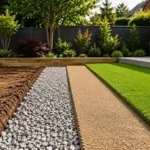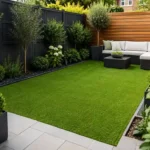
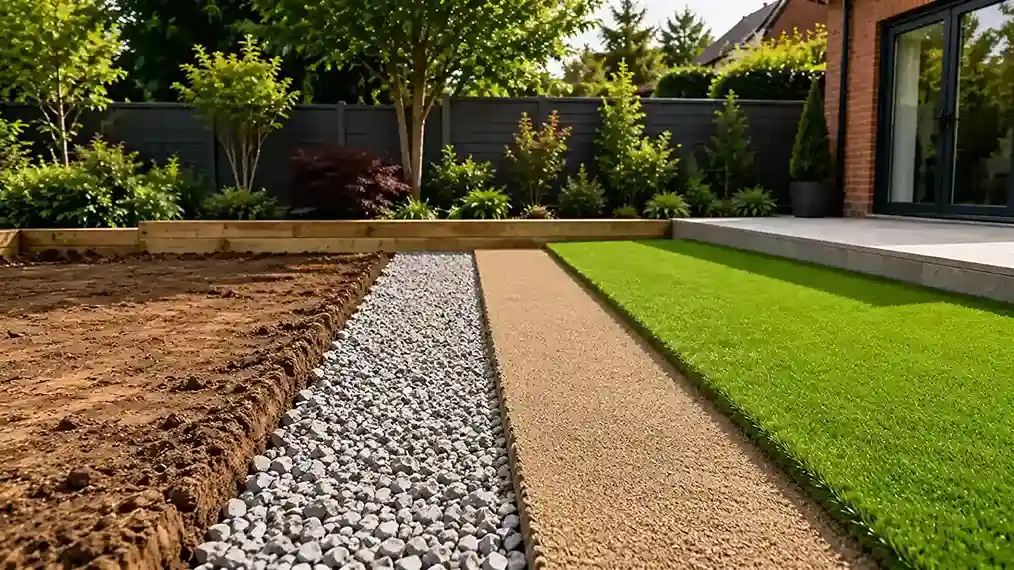
The artificial lawn is the part you see. The work that determines whether it sits flat, drains properly and meets the surrounding paving neatly is mostly hidden underneath it. Good artificial grass groundwork starts by understanding the existing garden. The old lawn and unsuitable organic material generally need to be removed, levels established, drainage considered and a stable sub-base prepared before the artificial turf is fitted. The exact construction should reflect the condition of the ground, the intended use of the lawn, and the requirements of the chosen artificial grass system. That means there is no sensible universal excavation depth or one base specification that should be copied into every Bournemouth garden.
Start With the Garden, Not the Artificial Grass
Before anything is excavated, the installer needs to know what the existing ground is doing. Does the lawn remain wet after rain? Are there obvious dips? Does water run off a neighbouring patio? Is the garden level or does it fall towards the house? Where will excavated soil leave the property? These questions affect the installation before a roll of artificial turf is ordered. A site assessment should consider the soil condition, existing lawn, surface-water movement, surrounding paving, boundaries, access and the height at which the completed lawn needs to finish. The intended use matters as well. A decorative lawn receiving occasional foot traffic may have different demands from a frequently used family garden. The principle is simple: artificial grass preparation should be designed around the site, rather than making the site fit a standard installation recipe.
What Usually Sits Under an Artificial Lawn?
Although specifications vary, a typical lawn conversion involves several separate components. From the existing ground upwards, the build-up may include:
- cleared and excavated ground
- a geotextile or separation membrane where specified
- compacted aggregate forming the structural sub-base
- a finer levelling or finishing layer where required
- perimeter edging
- the artificial grass itself
UK installation guidance from Wickes states that artificial grass should not simply be placed directly onto topsoil and explains that the depth and type of sub-layer depend on the soil beneath and the selected turf. Manufacturer guidance similarly emphasises removing organic material and preparing a compacted base, while noting that base requirements can vary according to the installation site. That flexibility is important. Ground conditions should determine the specification.
Removing the Existing Turf Is More Than Cutting Off the Grass
For an existing natural lawn, groundwork generally starts with stripping away the turf and removing unsuitable organic material. Roots, loose topsoil and vegetation should not simply be covered over. Organic material changes as it decomposes, which is one reason artificial-grass installation guidance recommends clearing turf, weeds, grass and roots before constructing the new base. How much excavation is required depends on what the installer finds and the finished levels that need to be achieved. A garden where the new lawn needs to meet an existing porcelain patio neatly may require a different build-up from a lawn surrounded entirely by planting beds. This is also where access begins to affect the project. Excavated soil has to leave the garden, while aggregate and other materials need to come in. On Bournemouth properties with restricted side access, much of that movement may need to be managed manually.
Levels Need to Be Decided Before the Base Goes Down
One of the easiest mistakes to notice after installation is a lawn that finishes awkwardly against another surface. Artificial grass should relate properly to paths, patios, decking, borders and garden steps. The perimeter height also needs to accommodate the pile of the chosen turf and the fixing method being used. This is why finished levels are established early.
The installer also needs to consider how water already moves across the garden. Correcting a dip in one area without understanding the wider gradient can merely push surface water towards somewhere else. Small adjustments during the artificial grass groundwork stage are considerably easier than trying to alter levels after the grass has been cut and fitted.
The Sub-Base Provides the Structure
After excavation and level preparation comes the part that gives the artificial lawn its foundation. A compactable aggregate is commonly used to form the structural sub-base. MOT Type 1 is one possible material used in certain systems, but it should not automatically be presented as the correct solution for every garden.
The choice depends on factors such as:
- existing subsoil
- drainage requirements
- intended traffic
- installation specification
- required finished height
Wickes, for example, recommends adapting the sub-layer to the soil conditions and notes that poorly draining ground can require a different approach from already compacted, free-draining soil. That is a much more useful principle than specifying an identical build-up for every artificial lawn.
Compaction Turns Loose Aggregate Into a Working Base
Simply spreading aggregate across the garden does not create a finished sub-base. The material needs to be levelled and mechanically compacted. Levels are then checked again so that dips, soft areas or unwanted high points can be corrected before the installation progresses. A plate compactor is commonly used for this stage. Manufacturer guidance recommends mechanical compaction because it creates a firmer base than hand tamping alone. This work may look repetitive, but it has a straightforward purpose. Artificial grass follows the shape of the surface beneath it. If that surface is poorly prepared, imperfections are much harder to disguise once the final turf has been installed.
What Is the Finishing Layer For?
Some installation systems use a finer aggregate above the structural sub-base. Materials such as granite dust or other suitable laying aggregates can create a smoother final surface before the artificial grass is introduced. The precise product and thickness should follow the installation specification rather than being chosen simply because another garden used the same method. This distinction matters because the sub-base and finishing layer do different jobs. The structural base provides stability. The upper layer helps create the final profile and smooth surface required for the chosen artificial lawn. Both then need appropriate levelling and compaction.
Drainage Has to Work Beneath the Lawn
Artificial turf may allow rainfall through its backing, but that does not mean the garden underneath automatically becomes well drained. The water still needs somewhere to go. If an existing Bournemouth lawn regularly contains standing water, laying artificial grass over the same poorly draining ground is not a drainage solution. The cause of the waterlogging should first be investigated. A landscaper may need to assess:
- Soil permeability: How readily does water move into the existing ground?
- Low areas: Are particular sections collecting runoff?
- Surrounding surfaces: Are patios or paths directing additional water towards the lawn?
- Existing drainage: Is there already a system that needs to be retained or corrected?
- Sub-base permeability: Is the proposed construction appropriate for the site’s drainage requirements?
Additional drainage may be required in some gardens, while others may perform adequately with appropriate levels and a suitable permeable build-up. There is no reason to prescribe a French drain or soakaway for every artificial lawn. If persistent waterlogging already exists, it is better to address the underlying garden drainage problem before covering the area.
Do You Need a Membrane Under Artificial Grass?
Often, but it is important to know what the membrane is intended to do. The term “weed membrane” is frequently used for several different products. In practice, a geotextile can also act as a separation layer between native soil and the aggregate construction. Golden Select’s installation guidance, for example, specifies geotextile fabric between native soil and base material as part of its ground-installation method. Wickes describes a permeable landscaping membrane within its own installation system. The important point is that the type and position of the membrane depend on the installation design. It should not simply be added because every artificial lawn is assumed to require an identical layer arrangement.
Why the Perimeter Needs Planning Early
Edges can easily be treated as a finishing detail. They are actually part of the groundwork. An appropriate perimeter helps retain the prepared base and provides a suitable way of finishing or securing the artificial grass. Depending on the garden and installation method, this may involve timber, composite, concrete or existing hard boundaries. The finished height needs careful thought. If edging is too high, the artificial lawn may sit noticeably below it. Too low, and the installation may not achieve the intended clean transition. Planning the edges before the final base is prepared also makes it easier to create consistent levels around the entire lawn.
Can Artificial Grass Be Laid Directly on Soil?
For a typical garden-lawn conversion, laying artificial grass directly over unprepared soil is not recommended. Soil can move, vegetation can return and existing drainage problems remain unresolved. The finished lawn is also unlikely to have the stable, consistent surface created by a properly prepared base. Wickes specifically advises using a sub-base rather than installing artificial grass directly onto topsoil.
Concrete or existing paving may sometimes form part of an artificial-grass installation, but it needs to be assessed for condition, level and drainage first. Non-porous surfaces can require a different drainage approach from installations over soil. The existing surface changes the method.
Five Groundwork Shortcuts Worth Avoiding
A professional installation should be based on what is actually found on site. Common shortcuts to avoid include:
- Ignoring existing waterlogging: Artificial grass will not remove the underlying cause.
- Insufficient compaction: A loose base is more susceptible to movement and unevenness.
- Guessing the finished level: Patios, paths and boundaries should be considered before construction.
- Using one specification everywhere: Soil and drainage conditions differ between gardens.
- Leaving perimeter planning until the end: Edging affects both base retention and the final appearance.
These are groundwork issues rather than problems with the artificial turf itself.
What Does This Mean for Bournemouth Gardens?
There is no single Bournemouth ground condition that should be assumed across every property. One garden may have straightforward access and freely draining ground. Another may contain previous landscaping, compacted soil, level changes or recurring surface water. That is why artificial grass groundwork in Bournemouth should begin with an individual assessment.
NexGen Landscapes provides artificial grass installation as part of its landscaping services across Bournemouth, alongside natural turf and wider garden improvements. Where artificial grass forms part of a larger redesign, the groundwork should also be coordinated with patios, paths, drainage and garden levels rather than treated as an isolated feature.
A Good Artificial Lawn Starts Below Ground
Once an artificial lawn is finished, almost none of its groundwork remains visible. That does not make it any less important. The sequence is straightforward in principle: assess the site, remove unsuitable material, establish levels, deal with drainage, construct and compact the base, prepare the perimeter and only then fit the artificial grass.
NexGen Landscapes can assess Bournemouth gardens for artificial grass installation and plan the preparation around the actual ground, drainage and surrounding landscaping. The grass provides the final appearance. The groundwork is what gives it a suitable place to sit.
Frequently Asked Questions
What Is the Best Base for Artificial Grass?
There is no single best base for every installation. Ground conditions, drainage, intended use and the chosen artificial grass system should determine the build-up.
How Deep Should Artificial Grass Groundwork Be?
There is no universal excavation depth. The required depth depends on the existing surface, sub-base specification, drainage and finished lawn level.
Does Artificial Grass Need Drainage Underneath?
Water needs to pass through or away from the complete installation. If the existing garden is waterlogged, its drainage should be assessed before artificial grass is installed.
Do You Have to Remove Natural Grass First?
For a normal lawn conversion, existing turf and unsuitable organic material are generally removed before the new base is prepared.
Can Artificial Grass Go Over Concrete?
It may be possible, but the concrete should first be assessed for condition, levels and drainage because a hard, non-porous surface requires a different installation approach.
How Long Does Artificial Grass Ground Preparation Take?
It depends on the size of the area site access, excavation, drainage, existing ground and complexity of the required base.