If you are planning a new patio, the obvious question is not only what it will look like, but how long your garden will be under construction. For a straightforward patio installation in Bournemouth, several working days may be enough. Larger patios, awkward access, extensive excavation, drainage work, complicated laying patterns or additional features can extend the programme considerably. NexGen Landscapes itself advises that a straightforward patio may take several days, while larger or more complex installations can take longer.
The important point is that laying the visible paving is only one part of the job. Much of the time is spent underneath it, preparing ground that homeowners will never see once the patio is finished. So rather than asking how quickly slabs can be laid, it is more useful to understand what happens during each stage of the installation.
Before the First Slab Arrives
A reliable timeline starts before excavation. The proposed patio needs to be measured, materials selected, and practical details agreed. The installer also needs to understand how materials and machinery will reach the working area. A patio immediately behind a house with wide side access is a very different job from one at the end of a terraced garden where everything has to pass through a narrow gate or even through the property.
Before work starts, the installer may need to consider:
- Size and shape: A simple rectangular terrace is normally easier to set out than several connected areas.
- Existing surface: Old paving, concrete, decking, turf or planting may need removing.
- Levels: The finished patio has to work sensibly with doors, lawns, paths and surrounding ground.
- Drainage: Rainwater movement should be considered before the paving is installed.
- Materials: Porcelain, natural stone and concrete products can have different installation requirements.
Getting these decisions settled early makes delays less likely once the garden has been opened up.
The Groundwork Often Determines the Schedule
Homeowners naturally notice the day paving starts appearing. From an installation point of view, however, the groundwork may be more important. The area first needs to be cleared and excavated to suit the proposed construction. Unsuitable loose material is removed before an appropriate sub-base and laying system are prepared. Paving manufacturers place considerable emphasis on this stage. Marshalls, for example, describes base preparation and sub-base installation as essential stages when laying porcelain paving rather than optional preliminary work. This is why two patios of exactly the same dimensions can have very different timelines.
One may be built on relatively straightforward ground with easy access. Another may reveal:
- unstable or disturbed ground
- old concrete beneath the lawn
- tree roots
- unexpected level differences
- drainage problems
- buried construction waste
- an existing patio that is difficult to remove
A sensible contractor allows the site conditions to determine the preparation rather than rushing this stage simply to keep to an optimistic completion date.
When Does the Paving Actually Get Laid?
Once the foundation is ready, the patio starts looking much more like the finished project. The area is set out carefully, and paving is laid according to the chosen material and pattern. Lines, levels, spacing and falls need regular checking as the work progresses. Porcelain paving, for example, has particular installation requirements. Manufacturer guidance commonly calls for porcelain slabs to be laid on a full mortar bed with an appropriate primer or bonding slurry applied to the reverse.
Natural stone has its own characteristics. Variation between individual pieces can mean the installer needs to spend additional time selecting and arranging slabs so that the finished surface looks balanced. A straightforward grid using consistent slab sizes is generally less labour-intensive than a design involving numerous cuts, borders, steps or combinations of different paving sizes. The fastest installation is therefore not necessarily the one that produces the finish you actually want.
Patio Size Matters, but It Is Not the Whole Story
It would be convenient if patio installation time could be calculated simply by square metres. In practice, that can be misleading. Consider two similarly sized projects. The first is a rectangular patio outside rear doors with clear access and a straightforward paving pattern. The second includes a curved border, several steps, drainage channels, raised planting and numerous cuts around existing features. Their surface areas may be similar, but the amount of detailed work is not. When arranging patio installation in Bournemouth, homeowners should therefore expect contractors to consider complexity as well as overall dimensions. A site visit is much more useful for estimating the programme than trying to calculate the installation time from measurements alone.
Why Drainage Can Add Time but Should Not Be Rushed
Drainage needs to be considered before paving is laid, because a new patio changes how rainwater moves across the garden. If standing water is already present, the installer may need additional time to assess the cause and decide how the surface should be constructed.
Key drainage considerations include:
- Surface falls: The patio should be laid with suitable falls so water does not collect unnecessarily.
- Existing drainage: Channels, gullies or other drainage points should be checked before installation begins.
- Standing water: Persistent pooling may indicate a wider drainage or ground-level problem that needs attention first.
- Garden levels: Adjusting levels can improve water movement but may add excavation and preparation time.
- Drainage channels: These may be required where runoff needs to be controlled around hard landscaping.
- Surrounding areas: Lawns, planting beds and other permeable areas should be considered as part of the overall drainage plan.
- Planning restrictions: Listed buildings, unusual properties or sites with specific planning controls may require additional checks before work starts.
Taking extra time to manage drainage correctly is preferable to completing the paving quickly and discovering water-management problems afterwards.
Does Porcelain Take Longer Than Natural Stone?
The material influences the installation method, but it is rarely the only factor controlling the overall schedule. Porcelain requires careful setting out, cutting and suitable bonding to the mortar bed. Natural stone may require more selection and adjustment because of variations between pieces. What tends to matter more is the combination of:
material + patio size + pattern + groundwork + access + detailing.
A simple porcelain patio may therefore be faster to complete than a highly detailed natural-stone scheme, while another project could be the reverse. Material selection should be based primarily on appearance, suitability, maintenance expectations and the wider Expert garden design rather than trying to save a small amount of installation time.
What Happens After the Slabs Are Down?
A patio is not finished simply because every paving slab is in position. Joints still need completing using a system appropriate to the paving specification. Edges, cuts, surrounding levels and transitions to lawns or paths need finishing as well. Mortar, grout and jointing products also require appropriate setting or curing conditions. Manufacturer instructions should determine when subsequent stages take place and when the finished surface can be put into normal use. Talasey’s jointing guidance, for example, requires the paving’s mortar bed to be sufficiently set before grout is applied. That final waiting period can feel frustrating when the patio looks ready. Using the space prematurely simply to gain a day is rarely worth interfering with the setting process recommended for the materials used.
Can Rain Delay Patio Installation in Bournemouth?
Yes, weather can affect the programme. Outdoor construction depends on suitable conditions for excavation, mortar work, jointing and other installation stages. Product manufacturers also advise protecting paving materials and newly installed work from unsuitable weather conditions. A brief shower does not automatically stop an entire project, but prolonged wet weather can make excavation difficult, saturate prepared ground or prevent particular products from being used as intended. The practical approach is to allow some flexibility. A contractor promising an exact completion day weeks in advance, regardless of weather or unknown ground conditions, may be offering certainty that an outdoor construction project cannot realistically guarantee.
A Better Way to Think About Your Patio Timeline
Every stage prepares the next one. Skipping preparation might make the patio appear to progress faster during the first few days, but speed is not a useful measure if it compromises the construction underneath. For homeowners planning a patio installation in Bournemouth project, it is reasonable to ask the contractor for an estimated programme after they have inspected the site. You should also ask what might alter that programme. Access restrictions, unexpected ground conditions, weather, additional drainage and design changes are much easier to deal with when expectations have already been discussed.
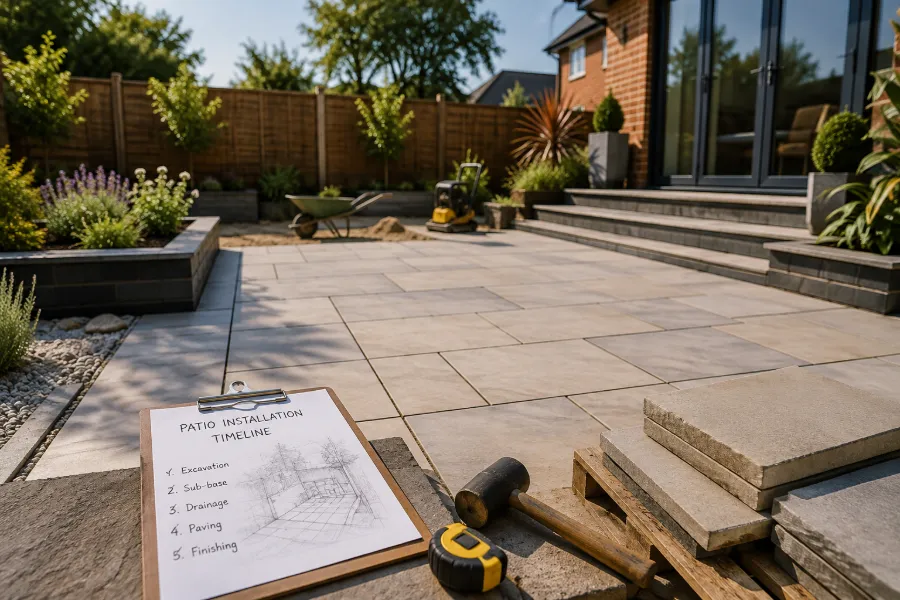
Survey and planning → clearance → excavation → sub-base preparation → drainage and levels → paving installation → cutting and detailing → jointing → setting → final checks
How Long Should You Allow for Your Bournemouth Patio?
There is no single installation time that applies to every garden. A straightforward project with easy access and limited preparation may progress within several working days. A larger scheme involving demolition, challenging access, drainage, steps, detailed cutting or complex levels will naturally require more time. The best estimate comes after the garden has been inspected, not from an online square-metre calculation.
NexGen Landscapes provides patios and paving in Bournemouth, with projects planned around the chosen materials, site access, groundwork, drainage and overall garden layout. Its existing patio service guidance likewise notes that straightforward installations may take several days, with larger or more complex projects requiring longer. If you are considering a new patio, focus first on getting the preparation and installation sequence right. A few extra days spent dealing properly with the ground beneath the paving can matter far more than finishing the visible surface as quickly as possible.
Frequently Asked Questions (FAQs)
How Long Does Patio Installation Take?
A straightforward patio may take several working days, while larger or more complicated projects can take longer. Groundwork, access, drainage, materials and design details all influence the programme.
What Part of Patio Installation Takes the Most Time?
This varies by project, but excavation, ground preparation, detailed cutting and drainage can account for a significant amount of labour before and during paving installation.
Does an Old Patio Need to Be Removed First?
Usually, the installer will assess the existing surface and proposed construction before deciding what preparation is necessary. Existing paving should not simply be assumed to provide a suitable base.
Can I Use a New Patio Immediately?
Not always. Mortars and jointing products need sufficient time to set or cure according to their manufacturer’s instructions before normal use.
Does Bad Weather Delay Patio Installation?
It can. Prolonged rain and unsuitable conditions may interrupt groundwork, paving, mortar or jointing stages, so some flexibility should be allowed in outdoor construction schedules.
Can Drainage Make a Patio Project Take Longer?
Yes. If levels need adjusting or drainage measures are required, additional preparation may be necessary. Completing this work properly is preferable to discovering water problems after the paving has been finished.