
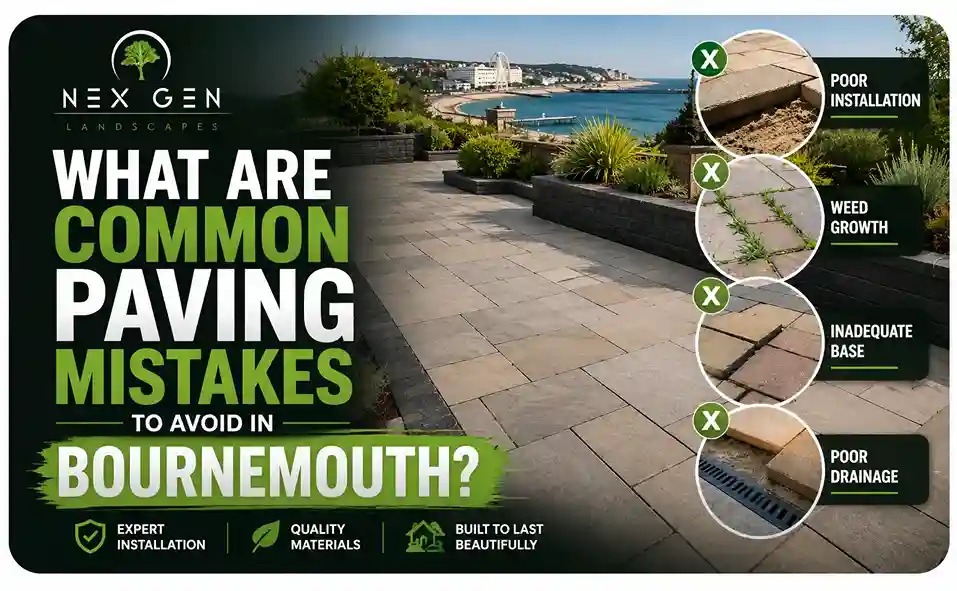
Ever admired a beautiful new patio, then noticed two years later it’s cracked, sunken, or covered in weeds? We see it constantly. At NexGen Landscapes, Bournemouth homeowners call us every week to repair patios laid the first time — and the frustrating bit? Most issues were completely avoidable. Learning the paving mistakes to avoid in Bournemouth could save you thousands and years of regret. Here are the most common ones we see across Dorset.
1. Skipping Proper Sub-Base Preparation
This is the number one cause of failed patios in Bournemouth — hands down. The sub-base is the layer of compacted hardcore that sits beneath your paving. It’s what keeps everything level stable and supported for the next 20+ years. Yet so many installers (and DIYers) cut corners here because well no one sees it once the slabs are down.
What goes wrong:
- Sub-base is too shallow (less than 100mm for patios, 150mm for driveways)
- Hardcore isn’t properly compacted
- Builders use cheap or wrong-grade aggregate
- The ground isn’t excavated deep enough
What it leads to:
- Sinking slabs within 6–12 months
- Wobbly, uneven patios
- Cracked slabs
- Water pooling
Pro tip from our team: Always insist on MOT Type 1 hardcore, compacted in layers using a wacker plate. If your installer skips this step or rushes it — walk away.
2. Choosing the Wrong Paving Material
Bournemouth homeowners often pick Different Types of Patio Materials based purely on looks — and end up regretting it within a year.
Each material behaves differently in our coastal climate:
| Material | Suits Bournemouth? | Why |
|---|---|---|
| Porcelain | Excellent | Non-porous, frost-resistant, salt-air friendly |
| Granite | Excellent | Tough, low-maintenance, great near coast |
| Sandstone | Okay | Beautiful but needs sealing every 2–3 years |
| Limestone | Okay | Stains easily, can fade |
| Concrete slabs | Poor | Crack, fade, and look tired fast |
If you live near the seafront or in salt-spray areas like Southbourne or Boscombe, porcelain or granite are usually the smartest long-term choices.
3. Poor Drainage and Incorrect Slope
You’d be amazed at how many “professional” patios we’ve ripped up because water sat on them like a paddling pool every time it rained. Every patio in Bournemouth needs a minimum fall of 1:80 (that’s about 12mm per metre) away from the house. No exceptions.
Common drainage mistakes:
- Patio is completely flat (water pools)
- Slope runs towards the house (causes damp walls!)
- No linear drainage is installed for larger patios
- Sub-base traps water with no escape route
If water can’t drain away properly, you’ll get moss, algae, frost damage, and slippery surfaces by your second winter. In the worst cases, it can even cause damp problems inside your home.
4. Incorrect Jointing and Pointing
The gaps between your paving slabs aren’t just decorative — they’re essential to the longevity of your patio.
What we see go wrong:
- Joints filled with plain sand (washes out in rain)
- The wrong mortar mix was used
- Joints too narrow (cracks under thermal expansion)
- Cheap jointing compound that breaks down within a year
The fix? Use a quality resin-based jointing compound like Geo-Fix or NexusPro. Yes, it costs more — but it lasts 10+ years and stops weeds growing through.
5. Not Sealing Natural Stone Paving
If you’ve chosen natural stone (sandstone, limestone, slate), sealing isn’t optional in Bournemouth — it’s essential.
Our coastal climate accelerates:
- Efflorescence (white salty residue)
- Moss and algae growth
- Stone staining from leaves and bird droppings
- Colour fading
Sealing should be done within the first month of installation and reapplied every 2–3 years. Skipping this step is one of the biggest paving mistakes to avoid in Bournemouth, and it dramatically shortens your patio’s lifespan.
6. Hiring an Inexperienced Installer
Let’s be honest — anyone can buy a few tools, set up an Instagram page, and call themselves a paving expert. We see the aftermath of these jobs all the time.
Red flags to watch out for:
- No portfolio of completed Bournemouth projects
- No public liability insurance
- Quotes way below the average market rate
- Pushing you to pay large deposits in cash
- No written contract or guarantee. Vague answers about sub-base or drainage
What a good installer looks like:
- Verified Checkatrade or Trustmark approved
- Provides written quotes with material specs
- Offers a workmanship guarantee (5+ years)
- Can show you previous local projects
- Explains the full process clearly
7. Ignoring Bournemouth’s Coastal Weather
I’ve already touched on this, but it deserves its own section because it’s that important.
Bournemouth’s coastal location means your paving has to deal with:
- Salt-laden sea air: corrodes cheap finishes
- Heavy autumn rainfall: tests drainage to its limits
- Occasional frost: destroys porous, water-logged slabs
- High UV exposure in summer: fades cheap pigmented concrete
A patio that would last 25 years in Birmingham might only last 8 years in Southbourne if it’s not specced for the environment. Always tell your installer where you live — and ensure they account for it.
How to Avoid These Paving Mistakes in Bournemouth
Here’s the short version — pin this to your fridge if you’re planning a project:
- Insist on 150mm MOT Type 1 sub-base, properly compacted
- Choose paving materials suited to coastal weather (porcelain or granite)
- Ensure a 1:80 fall away from your home
- Use resin-based jointing compound, not loose sand
- Seal natural stone within 30 days of laying
- Hire a Checkatrade/Trustmark verified installer with local references
- Get everything in writing, including guarantees
Final Thoughts
Paving might look simple, but as you can see, there’s a lot more going on beneath the surface — literally. The good news is that every mistake on this list is completely avoidable when you choose the right materials, the right installer, and the right approach for Bournemouth’s unique coastal climate. At NexGen Landscapes, we believe a well-laid patio doesn’t just look beautiful — it adds value to your home, makes your garden more enjoyable, and lasts decades without giving you grief.
Frequently Asked Questions
How long should a properly laid patio last in Bournemouth?
With a quality installation and the right materials, a patio in Bournemouth should easily last 20–30 years. Porcelain can last even longer with minimal maintenance.
Why is my new patio already sinking?
Almost always due to poor sub-base preparation or inadequate compaction. Unfortunately, this can’t be fixed without lifting the slabs and starting again.
Can I DIY my patio to save money?
You can — but for anything larger than a small garden path, we honestly don’t recommend it. The cost of fixing a botched DIY job usually exceeds the cost of hiring a pro in the first place.
How much does it cost to fix a badly laid patio in Bournemouth?
Repair costs typically range from £60–£120 per m², depending on the damage. A full re-lay can cost almost as much as the original installation.
Do I need planning permission for paving in Bournemouth?
Usually not for back gardens. For front driveways over 5m², you’ll need either permeable paving or planning permission under SuDS regulations to comply with BCP Council guidelines.